SR22 Insurance for Non-Owners: Get Your License Back Without a Car
Has the state told you to file an SR-22, but you don't own a vehicle? A non-owner SR-22 policy is usually the fastest and cheapest way to meet the requirement. Compare quotes from agents who file non-owner SR-22s every day.
- Same-day electronic filing in most states
- DUI, suspension and no-insurance tickets accepted
- No car required
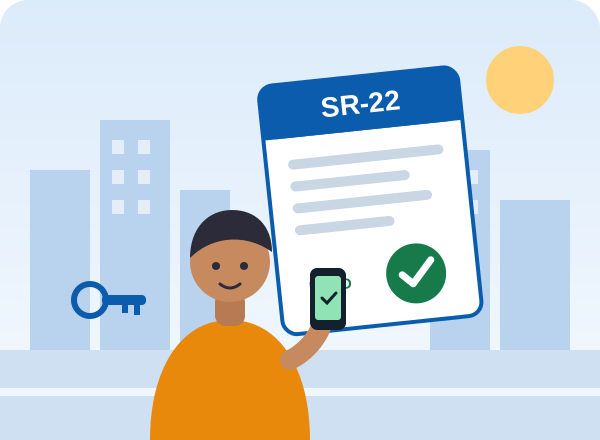
What is non-owner SR-22 insurance?
An SR-22 is not insurance. It is a certificate that your insurance company files with the state to prove that you carry at least the minimum liability coverage. Courts and DMVs usually require one after a DUI, after driving without insurance, after too many points, or to reinstate a suspended or revoked license.
A non-owner SR-22 pairs that certificate with a non-owner car insurance policy. That is a liability-only policy that covers you when you drive cars you do not own, such as rentals, borrowed cars, or a friend's vehicle. Because the policy does not insure a specific car, it typically costs much less than a standard SR-22 policy.

1. Get a quote
Tell us your state and why you need the SR-22. An agent compares carriers that write non-owner SR-22 policies.
2. We file it
Once you buy the policy, the insurer files the SR-22 (or FR-44) with your state, usually electronically within one business day.

3. Reinstate your license
Pay any state reinstatement fee, and you are back on the road. Keep the policy active for your full filing period.
Who needs SR-22 insurance as a non-owner?
A non-owner SR-22 is a good fit if all of the following are true:
- A court or DMV has ordered you to file an SR-22 (or an FR-44 in Florida or Virginia).
- You do not own a vehicle and do not have one registered in your name.
- You do not have regular access to a car in your household, such as a spouse's or roommate's car that you drive daily.
Common situations include sold or totaled cars, cars repossessed after a DUI, people who rely on transit or rideshare but need a valid license for work, and drivers who want to keep the SR-22 clock running until they buy a car. If you live with someone who owns a car you drive, an insurer will usually require you to be listed on that policy instead. See non-owner SR-22 vs. being added to someone's policy.
How much does non-owner SR-22 insurance cost?
National studies put the average non-owner SR-22 policy at roughly $480 to $900 a year, or about $40 to $75 a month. That is often less than half the cost of a standard SR-22 policy on a car you own. Your price depends on:
- Your state: Rural, low-limit states are cheapest. New Jersey, Connecticut and Delaware are among the most expensive.
- The reason for the SR-22: A DUI usually costs more than a lapse in coverage.
- Your liability limits: FR-44 states require higher limits, which raise the premium.
- Filing fee: Most insurers charge a one-time fee of about $15 to $50 to file the form.
Read the full breakdown in our non-owner SR-22 cost guide.
What non-owner SR-22 insurance covers
| Covered | Not covered |
|---|---|
| Bodily injury liability to others when you are at fault | Damage to the car you are driving (collision or comprehensive) |
| Property damage liability to others | Your own injuries (unless your state adds PIP or MedPay) |
| Secondary coverage above the car owner's policy | Cars you own or regularly use |
| Rentals and occasionally borrowed vehicles | Commercial use such as delivery or rideshare driving |
Non-owner SR-22 by state
Each state sets its own minimum limits and filing period, and a few states use a different form entirely. Choose your state:
CaliforniaTexasFloridaIllinoisGeorgiaOhioArizonaVirginiaMissouriIndianaNevadaColorado All states →
Non-owner SR-22 after a DUI
A DUI is the most common reason drivers need a non-owner SR-22. Many people lose or sell their car after an arrest but still need the filing to get a restricted or full license back. Some states also require an ignition interlock device, which you generally cannot install without a vehicle. Learn how this works in our DUI non-owner SR-22 guide. If you live in Florida or Virginia, read about the non-owner FR-44.
Frequently asked questions
Can I get an SR-22 if I don't own a car?
Yes. A non-owner car insurance policy with an SR-22 endorsement satisfies the requirement in almost every state that uses SR-22s. The insurer files the form for you.
How fast can a non-owner SR-22 be filed?
Most insurers file electronically, and many states receive the filing the same day or the next business day. Some states still process paper filings, which can take one to two weeks.
How long do I need a non-owner SR-22?
Most states require three years, but the period ranges from one to five years depending on the state and the violation. A lapse can restart the clock. See how long you need an SR-22.
Can I drive a friend's car with a non-owner SR-22?
Yes, occasionally. The car owner's insurance pays first, and your non-owner policy adds secondary liability coverage. You cannot use it for a car you drive regularly.
What if I buy a car later?
Tell your insurer right away. You will switch to a standard owner's policy, and the insurer files a new SR-22 so that there is no gap in your filing.